
Chin Augmentation Memphis, TN
The chin strongly influences facial proportion and profile. When it lacks projection, the nose may appear more prominent, the jawline can look less defined, and the lower face may seem out of balance with the rest of the features.
Chin augmentation, also called mentoplasty or chin implant surgery, adds projection and shape to a small or recessed chin using a biocompatible facial implant. The procedure can strengthen the profile, improve the relationship between the nose, lips, and chin, and create greater definition through the lower face.
At The Langsdon Clinic in Germantown, Dr. Phillip R. Langsdon and Dr. Sarah E. Langsdon approach chin augmentation as part of the overall facial structure. Dr. Phillip Langsdon has spent decades specializing in facial plastic surgery, while Dr. Sarah Langsdon completed a six-year integrated plastic surgery residency followed by additional fellowship training in facial aesthetic surgery.
The Langsdon Clinic invites you to contact our office or call (901) 755-6465 to discuss your chin augmentation goals.
What Is Chin Augmentation?
Chin augmentation increases the projection or definition of the chin using a surgically placed implant.
The implant rests over the existing chin bone and is selected according to the patient’s anatomy and the amount of projection or contour desired.
Chin augmentation may improve:
- A small or recessed chin
- Limited chin projection
- An imbalanced side profile
- Poor definition between the chin and neck
- Facial proportions that make the nose appear overly prominent
- A lower face that appears weak relative to the cheeks or midface
The procedure may be performed on its own or together with rhinoplasty, facelift surgery, neck rejuvenation, or treatment beneath the chin.
Why Does Chin Projection Matter to the Facial Profile?
The nose, lips, and chin are closely related when viewed from the side.
A chin with limited projection can make the nose appear larger than it actually is. It can also reduce definition along the lower face and change the apparent angle between the chin and neck.
One commonly used reference during profile evaluation is the relationship between the chin and a vertical line extending downward from the lower lip. A chin that sits significantly behind this area may benefit from additional projection.
That measurement is only one part of the evaluation. Facial width, jaw shape, nose size, lip position, neck contour, and the patient’s natural proportions all influence how much augmentation looks appropriate.
Chin Augmentation Before and After Images
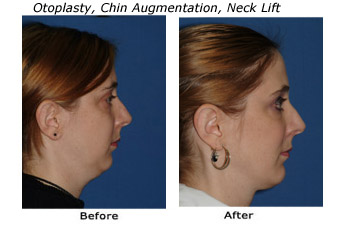
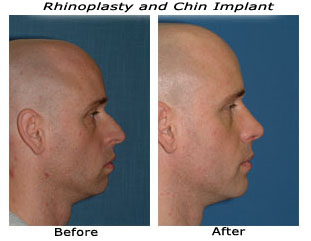
Can Chin Augmentation Make My Nose Look Smaller?
Chin augmentation does not physically change the nose, but improved chin projection can change how prominent the nose appears in profile.
A recessed chin may exaggerate the nose’s apparent size or projection. Strengthening the chin can create a more balanced relationship between these features.
This is one reason surgeons carefully evaluate chin position during rhinoplasty planning. In selected patients, rhinoplasty and chin augmentation can be performed together to improve the profile from both directions.
View Gallery
Visit our Before and After Photo gallery to see real patient results at The Langsdon Clinic.
Can a Chin Implant Improve the Jawline?
A chin implant can improve definition at the front of the jaw and strengthen the transition between the lower face and neck.
Its effect on the remainder of the jawline depends on the patient’s anatomy. Loose neck skin, excess submental fat, jowling, or significant tissue laxity require separate evaluation.
When several areas contribute to poor lower-face definition, chin augmentation may be combined with neck lift surgery, facelift surgery, or treatment of excess fat beneath the chin.
Who Is a Good Candidate for Chin Augmentation?
Chin augmentation may be appropriate for healthy adults who have finished facial growth and want greater chin projection or definition.
Candidates commonly have:
- A naturally small or recessed chin
- A weak-looking profile
- Limited lower-face definition
- Good general health
- Stable jaw and dental alignment
- Realistic expectations for the change surgery can provide
Smoking can interfere with surgical healing, so patients who smoke or vape may need to stop before and after surgery.
Can Chin Augmentation Correct Jaw or Bite Problems?
A chin implant changes the outward contour of the chin. It does not reposition the jaw or correct dental alignment.
Patients with significant bite problems, jaw asymmetry, or skeletal irregularities may need evaluation by a dental, orthodontic, or oral and maxillofacial specialist.
This distinction is important during consultation. A chin that appears recessed because of the underlying jaw position may require different treatment from a normally aligned jaw with limited chin projection.
What Happens During a Chin Augmentation Consultation?
Consultation begins with an evaluation of the entire facial profile.
Dr. Phillip Langsdon or Dr. Sarah Langsdon considers the chin’s size and projection along with the nose, lips, jawline, neck, and surrounding facial features. Dental alignment and the underlying shape of the lower jaw may also influence the recommendation.
The consultation is also an opportunity to discuss:
- The amount of projection you would like
- Implant size and shape
- Incision placement
- Whether another facial procedure would improve overall balance
- Anesthesia
- Recovery
- Potential risks
- Expected changes from the front and profile
Before-and-after photographs can help illustrate the range of results possible, although every patient’s anatomy is different.
How Is Chin Augmentation Performed?
Chin augmentation is performed at The Langsdon Clinic’s outpatient surgical facility in Germantown.
A small incision may be placed inside the mouth above the crease between the lower lip and gums or discreetly beneath the chin.
Your surgeon creates a precise pocket over the chin bone and positions the implant to achieve the planned projection and contour.
Careful placement is important because even a relatively small adjustment to the chin can noticeably change the balance of the profile.
What Type of Chin Implant Does The Langsdon Clinic Use?
The Langsdon Clinic commonly uses medical-grade implants with a mesh-like or porous structure.
The porous surface allows surrounding tissues to integrate with the implant, helping stabilize it as it heals. The material and shape are selected according to the patient’s anatomy and the type of augmentation being performed.
Other implant designs may be recommended when they better suit the surgical plan.
Where Are Chin Implant Incisions Placed?
The incision can be made either inside the mouth or beneath the chin.
An intraoral incision is concealed inside the lower lip and leaves no external skin scar.
An external incision is placed within the natural crease beneath the chin, where it can become relatively inconspicuous as it heals.
The choice depends on anatomy, implant selection, other procedures being performed, and the surgeon’s preferred access for the individual operation.
What Type of Anesthesia Is Used for Chin Augmentation?
At The Langsdon Clinic, chin augmentation is generally performed with twilight sedation combined with local anesthesia.
This approach keeps patients comfortable and generally unaware of the procedure while avoiding hospital-based general gas anesthesia in many cases.
The anesthesia plan is reviewed in advance and may vary when chin augmentation is combined with another facial procedure.
Can Chin Augmentation Be Combined with Rhinoplasty?
Yes. Chin augmentation and rhinoplasty are often considered together because both strongly influence the side profile.
Reducing nasal projection without evaluating a recessed chin can leave part of the original imbalance untreated. Likewise, improving chin projection may reduce how prominent the nose appears even though the nose itself has not changed.
Evaluating both structures during consultation allows the surgeon to determine whether treatment of one or both areas would improve facial balance.
Can Chin Augmentation Be Combined with a Facelift or Neck Lift?
Yes. Chin projection can significantly affect the appearance of the jawline and neck.
A facelift can improve jowling and lower-face aging, while a neck lift can address loose skin, muscle laxity, and fullness beneath the jaw.
When the chin itself is recessed, adding projection may further improve the transition between the face and neck.
Chin augmentation can also be combined with removal of excess fat beneath the chin when submental fullness contributes to the profile.
What Is Recovery Like After Chin Augmentation?
Recovery is generally brief when chin augmentation is done on its own.
A typical recovery may include:
- First several hours: A wraparound dressing may be used to provide support and help control swelling.
- First few days: Swelling, tightness, mild discomfort, numbness, or stiffness can occur around the chin.
- Around one week: Initial healing is usually well underway, and many patients can return to routine daily activities.
- Following weeks: Swelling continues to decrease, and temporary numbness or unusual sensations gradually improve.
- Following months: The implant feels increasingly integrated with the surrounding tissues and the final contour becomes more apparent.
The chin can initially look more prominent than expected because of swelling.
Patients who have chin augmentation with rhinoplasty or treatment beneath the chin may also return to many normal activities within about one week. When the procedure is combined with a facelift, the early recovery period is usually closer to two weeks because the surgery is more extensive.
When Will I See My Chin Augmentation Results?
The increase in chin projection is visible immediately, but swelling initially makes the chin appear larger and less refined.
A clearer sense of the new profile develops as swelling decreases during the first several weeks. The chin continues to settle and soften as healing progresses.
Subtle changes can continue for months, and complete surgical healing may take considerably longer than the initial visible recovery.
Are Chin Implants Permanent?
Chin implants are designed to provide long-term augmentation and do not require routine replacement simply because a certain number of years has passed.
The surrounding face continues to age normally, and changes in weight, skin quality, or other facial tissues can affect appearance over time.
Implant-related problems can occasionally require revision or removal, which should be discussed as part of the informed-consent process.
What Are the Risks of Chin Augmentation?
Chin augmentation is a surgical procedure and carries potential risks.
Possible complications include:
- Bleeding or hematoma
- Infection
- Changes in sensation or numbness
- Poor incision healing
- Unfavorable scarring
- Persistent swelling or discomfort
- Implant shifting or displacement
- Asymmetry
- Firm scar tissue around the implant
- Need for revision surgery
- Anesthesia-related complications
Your surgeon reviews the risks that are most relevant to your health, anatomy, implant choice, and surgical plan before surgery.

Request Your Facial Plastic Surgery Consultation
Board-certified facial plastic surgeon Dr. Phillip R. Langsdon is the only surgeon in the Mid-South whose practice is limited to and specialized in cosmetic surgery of the face, nose, eyes, head, and neck. A former President of the American Academy of Facial Plastic and Reconstructive Surgery, Dr. Langsdon has earned unprecedented recognition and praise as one of the best facelift and rhinoplasty plastic surgeons in America.
He is joined by Dr. Sarah E. Langsdon who completed a six year integrated plastic surgery residency at the University of Missouri and an additional fellowship specializing in facial aesthetic surgery.
Why Choose The Langsdon Clinic for Chin Augmentation?
Chin augmentation requires an understanding of the entire face. A change of only a few millimeters can alter the relationship between the chin, lips, nose, jawline, and neck.
The Langsdon Clinic approaches chin enhancement through that broader facial perspective.
Phillip R. Langsdon, M.D.
Dr. Phillip R. Langsdon is board-certified by the American Board of Facial Plastic and Reconstructive Surgery.
He trained in Otolaryngology–Head and Neck Surgery at Indiana University before completing an additional yearlong fellowship devoted to cosmetic facial surgery through the American Academy of Facial Plastic and Reconstructive Surgery.
Dr. Langsdon later served as President of the AAFPRS and has spent his career specializing in surgery of the face, nose, eyes, head, and neck.
That facial focus is particularly relevant to chin augmentation, where implant selection and placement need to be considered in relation to the nose, jawline, lips, neck, and overall profile.
Sarah E. Langsdon, M.D.
Dr. Sarah E. Langsdon earned her medical degree from the University of Tennessee Health Science Center in Memphis and completed a six-year integrated plastic surgery residency at the University of Missouri.
She then completed a yearlong fellowship with the American Society of Aesthetic Plastic Surgery specializing in facial plastic surgery.
Her approach combines extensive plastic surgery training with close attention to facial proportion, detail, safety, and individualized results.
Together, Drs. Phillip and Sarah Langsdon provide facial surgery patients with a detailed evaluation of how an individual procedure affects the balance of the face as a whole.
Request a Chin Augmentation Consultation in Memphis
At The Langsdon Clinic, Dr. Phillip Langsdon and Dr. Sarah Langsdon carefully evaluate your profile before recommending an implant or combining chin augmentation with another facial procedure. Patients receive a clear explanation of what surgery can accomplish, how the implant is placed, and what to expect throughout recovery.
Request a private consultation at The Langsdon Clinic in Germantown or call (901) 755-6465 to discuss chin augmentation and your options for improving facial balance.
Memphis Chin Augmentation FAQs
Chin implants are intended to provide long-term augmentation. They do not have a routine replacement schedule, although complications or changes in a patient’s preferences can occasionally lead to revision or removal.
It can. Increasing chin projection can strengthen the front of the jawline and improve the transition between the face and neck. Loose skin, excess fat, jowling, and other causes of poor jawline definition may require additional treatment.
Not always. The incision may be placed inside the mouth, where there is no external scar, or within a crease beneath the chin. When an external incision is used, it is placed so the resulting scar remains discreet.
Yes. Because the chin and nose strongly influence the profile, we often evaluate the two procedures together. Combining them may be appropriate when both nasal shape and limited chin projection contribute to facial imbalance.
Discomfort is usually mild. Most patients experience swelling, tightness, and mild discomfort during early recovery. The Langsdon Clinic typically performs the procedure with twilight sedation and local anesthesia, and postoperative discomfort can be managed according to the surgical team’s instructions.
Many patients who have chin augmentation alone can return to normal daily activities within about one week. Recovery may be longer when it is combined with a facelift or another more extensive procedure.
No. A chin implant improves the chin’s external projection but does not reposition the jaw or correct dental alignment. Significant bite or skeletal jaw problems may require evaluation by an appropriate dental or maxillofacial specialist.
It may improve the profile when limited chin projection makes fullness beneath the chin appear more prominent. If excess fat or loose skin is also present, the implant may be recommended along with treatment of the chin or neck.